Skip to content

carpe diem!

Often organizations find themselves waiting for the next strategic planning cycle. As individuals we wait to make New Year’s resolutions until January 1. It feels comfortable, “We’ve always done it that way; one more week won’t matter.”

Yet, there is nothing like the present moment for beginning to take action on moving our organizations and ourselves in new directions.

carpe diem! (seize the day)

Getting more of what we want

Anticipation

 At our house, against all efforts to re-focus on giving rather than receiving, I still hear the line, “I want _______ (you fill in the blank).” In organizations, this often comes out as people say, “If only _______ (you fill in the blank).”

But is that who we want to be? Is that who I want to be? … someone who asks others to meet my wants? … someone who lives in a world of “if only”?

My Dad has always said, “If you want to meet the right people, you must first be the right person.”  Or we might turn to Peter Drucker, “The successful person places more attention on doing the right thing rather than doing things right.”

As I anticipate the gifts of the holiday season, tangible and intangible, given and received, I seek to be the right person, to want what I have, and to engage in the present moment with hope and anticipation. When I’m focusing in the right direction, my dreams and possibilities have a chance of becoming reality.

Quiet desperation

Whatever your faith tradition, the U.S. culture this time of year is filled with celebrations and parties. The year is winding down while colorful lights push back the winter darkness. We are waiting, waiting for the shortest day of the year to be past, waiting for a new year with its possibilities.

Winter Lights

Yet, in this season of waiting and hoping for new possibilities, I still hear voices of resignation. People voice resignation to events around us that are out of our control, in our organizations, families, and the world. In Walden, Henry David Thoreau said, “The mass of men lead lives of quiet desperation. What is called resignation is confirmed desperation.”

And yet, we get to choose. A colleague reminded me that only 10% of our organization life comes to us through formal channels. The rest comes through informal interaction. In those information interactions, we get to take responsibility for ourselves, our behavior, our relationships, our development, our emotional, physical, and spiritual well-being.

I ask myself and challenge you to do the same, “What am I doing to develop my capacity to be authentic and present? Am I willing to interrupt my routine to reflect and then be proactive in my life? Am I willing to take responsibility for my actions, thoughts, and physical environment?”

As individuals, we can choose to contribute – appreciate – give freely, or we can choose to hoard – criticize – take. We can act to begin ending the cycle of resignation and desperation. We can act to take a walk, read an article or book, and offer a word of encouragement to those around us. We can be the light that helps to push back the darkness. We can be the change we wish to see in the world.

The courage to end management as we know it

Jon and I have long put forward the idea that leadership and management are two different things. We’ve defined management as the action of organizing the details of day-to-day operations. But often the word organizing becomes controlling. Yet years of research in human and organizational behavior show that controlling won’t get organizations the results they want.

Daniel Pink has a new book coming out in a few weeks. Here’s an excerpt:

Management is great if you want people to comply – to do specific things a certain way. But it stinks if you want people to engage – to think big or give the world something it didn’t know it was missing. For creative, complex, conceptual challenges – i.e, what most of us now do for a living—40 years of research in behavioral science and human motivation says that self-direction works better.

And that requires autonomy. Lots of it.

If we want engagement, and the mediocrity busting results it produces, we have to make sure people have autonomy over the four most important aspects of their work:

Task – What they do
Time – When they do it
Technique – How they do it
Team – Whom they do it with.

After a decade of truly spectacular underachievement, what we need now is less management and more freedom – fewer individual automatons and more autonomous individuals.

 . . . something worth thinking about. The challenge is to have the courage to go beyond thinking to gathering the courage to make the shift to a new way of engaging individuals in the workplace. If you want more to think about today, check out Justin Anderson’s take on shifting organizational culture.

What matters

Two evenings ago I was enjoying an evening of conversation with friends when one courageously asked, “What really matters?” I ask myself this question every day, but usually only to myself. So, I appreciated the opportunity to reflect with friends. The overall theme that I took away from the conversation was that what matters is that we act from our core values, which for me include truthfulness, compassion, grace, abundance, and collaboration.

If you’re asking yourself the same question, check out Seth Godin’s compilation of thoughts from more than 70 thinkers. As Godin says, “Now, more than ever, we need a different way of thinking, a useful way to focus and the energy to turn the game around.”

The reality management never sees

A recent diary entry from an employee in a research study was titled, “The Reality Management Never Sees.” While managers may have an unspoken agenda in the workplace, what they can’t see is how employees process life at work. In order to learn what happens inside of employees’ minds, for three years, researchers studied 238 professionals – persons who use their knowledge collaboratively to solve problems. The question for reflection in this post is, “What is the reality managers can’t see and how does understanding that reality change how they manage?”

The research shows that every person is affected by emotions created by reactions to events at work and by how they perceive and make sense of these events. This interplay of emotions and perceptions drive employees’ process of choosing what tasks to perform, how to do a task, and where to do it or in other words: their  motivation to perform. While this may not be surprising to a manager who has reflected on the question of how employees experience the workplace, the argument among managers is how performance is influenced by employees’ subjective experience.

The debate between managers is whether employees perform better when they’re self-directed, happier, and love what they’re doing or when supervisors pressure them to meet objectives and design competition among peer groups. The evidence showed three elements impacting performance:

  • Positive emotions such as happiness, pride, warmth, and love directly affect people’s ability to solve problems creatively and successfully. And not only are they more likely to be 50% more productive on a day with positive emotions, the surprise finding was that the succeeding day was more productive as well. The reverse was true with fear, anger, frustration, confusion, and sadness decreasing employees’ ability to make progress not only on a given day, but on succeeding days with productivity falling between 65% and 80%.
  • Individual perceptions of organizations and leaders as collaborative and cooperative, willing to consider new ideas, providing a meaningful vision, and willing to reward excellent work led to higher performance. Perceptions of political game playing and lack of trust and confidence in leadership led to an unwillingness to take risks and share ideas.
  • Motivation to perform at their best comes when persons are interested in the work they are doing, finding enjoyment and challenge in the work itself. Motivation dips when external pressures rise and rewards are based not on doing meaningful work, but on meeting external expectations.

High performance was described as increases in productivity, a commitment to the work at hand, and respect for and contribution to the work of team members. The inner reality of employees clearly impacts effectiveness, productivity, and team participation. So what can managers do that will have the biggest impact on employees’ inner experience – emotions, perceptions, and motivation?

Surprising to me was what did not make the list of good management behavior: daily thanking an employee, working side-by-side with an employee as a peer, injecting lighthearted jokes, or buying a pizza for lunch. While these do have an impact, the most important and fundamental management activities were:

  • Enabling progress by setting clear goals, communicating where the work is headed and why it matters and makes a difference; giving assistance when needed; providing resources and time to get the job done, and managing success and failure as learning opportunities. A few opposite examples include frequent changing of goals and objectives, placing obstacles in the way of progress, focusing on trivial issues, evaluating without explanation or learning, offering inadequate resources to reach the goal, forcing unnecessary time pressure, and engaging in political infighting.
  • Treating employees as human beings, with dignity and respect.

As employees are connected to their work 24/7 ripple effects from organizations spread through employees’ lives. This knowledge emphasizes the importance of understanding the inner life of employees, It is good for our organizations and reaffirms life and our value as human beings.

Read more about Inner Work Life at http://www.rotman.utoronto.ca/pdf/winter2008.pdf

Walking in the woods and Organization Development

What does walking in the woods have to do with Organization Development? Stress is necessary for life and work.  To-do lists keep us organized, Blackberries and iPhones keep us in communication, and performance goals keep us focused on the big picture. It’s when we become distressed that our work and organizaiton performance decreases as our bodies react as though there were a tiger just behind the wall. Whether we are overwhelmed gradually or suddenly by the circumstances around us, each person needs to find ways of regaining equilibrium – recharging their batteries.

We’ve all heard the experts talk about how to manage stress and distress successfully: exercise, eat a healthy diet, spend 10 minutes in meditation or prayer, get enough sleep, and spend time with people you care about and who care about you. Yet, too often I find myself making excuses, putting off the necessary action. I hear others doing the same.

Outdoors it is the fall season. The light comes late and fades early. Brilliant red leaves cover the ground under dormant trees. Green wheat covers the ground like a fuzzy blanket, waiting for the gift of snow and spring warmth. Fall – Spring. Light – Dark. Life – Death. Stress – Distress. As Parker Palmer says, “We want light without darkness, the glories of spring and summer without the demands of autumn and winter, and the Faustian bargains we make fail to sustain our lives.”

The challenge for each of us is to take action, to find a way to live the paradox that is stress and distress. Take a walk; each lunch with a friend; read a good book; enjoy a movie; spend some time sitting quietly and connecting with the world around you; sleep well. When we intentionally act to care for our physical, emotional, and spiritual well-being, our organizations and communities can thrive as we engage productively with the energy and innovation that come from well-being.

Action precedes transformation – for individuals and organizations. It is not enough to know what to do; we must do it. “You must be the change you with to see in the world.”

A walk in the woods

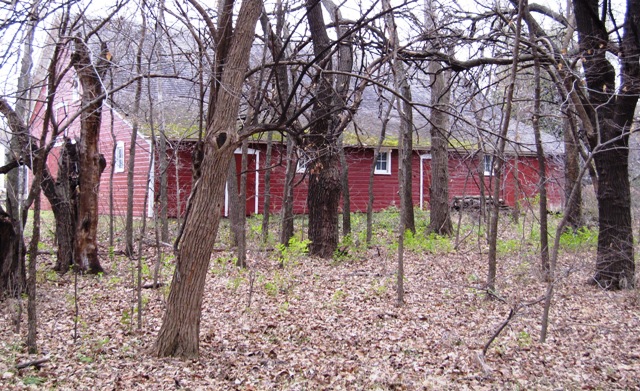
Walking away from the computer and into the woods is one of my favorite ways of managing stress. A walk in the woods allows me to step away from the challenges on my desk, re-focus my thoughts, and intentionally encounter the present. Here are some photos from today’s walk:

Sand Creek Trail Hedge Apple

Barn Along the Trail

Approaching Storm

As a friend wrote recently in her blog, “when I step back from our routine activities and try to see things with fresh eyes, I am reminded how much there is of value and beauty in the everyday.” I need to be sure to take time to reset . . . move away from the speed, chaos, and busyness around me . . . to stop processing what-could-have-been and what-might-be . . . to take a walk in the woods.

Being the change I wish to see . . .

“You must be the change you want to see in the world,” is a familiar quote from Mahatma Gandhi in organization change circles. Recently I’ve talked with several people about how organizational change happens. The consensus is that change begins with the individual.

If we want more trust in our organization, each of us must be more trusting. If we want more support for collaboration and communication, each of us must be willing to suspend our own opinions and our wish to be “right” while seeking to find workable solutions for all. If we want less conflict and tension, each of us must be willing to be calm and at peace with ourselves while genuinely caring for others. When I am open to transformation and actively work to change myself, I can become part of a chain of connections that opens a door for transformation and change that can benefit everyone.

Being open to change in myself is a life-long process. This process includes self-awareness and self-reflection, being willing to take responsibility for my own development. It asks me to make conscious choices, even in the midst of chaos. It asks me to practice being present with empathy, kindness, and compassion wherever I find myself. It asks me to make conscious choices about what to do and what to stop doing.

May each of us make a choice to be the change we all long for and wish to see. May we come to understand that how we treat ourselves, each other, and the world creates our experience. May we live into the answers for our questions. May our organizations be changed, one individual at a time.

Just tell me what to do!

“I’m committed to this organization, but I don’t understand what they want anymore. I wish they would just tell me what to do!”

The manager overhearing this conversation on the other side of a cubicle shrugs with frustration and thinks, “I’ve told them. They just don’t get it!”

What is the mystery that underlies this exchange? Managers spend time communicating goals, listening to concerns, and seeking to move the organization toward a shared vision and mission. Employees try to meet expectations and be a part of the team. But there is an unspoken agenda in many workplaces that can undermine the best intentions of managers and employees.

Hours are committed to writing accurate job descriptions. Some employers even develop replicable hiring criteria. Research shows that employees are so stressed by annual performance reviews that productivity suffers for weeks before and after the review. Yet few consider what is the most wished for workplace attribute: that people take on personal responsibility for their work and the organization — that people act as if they are self-employed at work.

Here are some of the unwritten attributes that define the self-employed at work phenomenon:

  • Be creative and inventive – see your work as owned by yourself, not by your employer or supervisor.
  • Be self-initiating and self-evaluating – identify problems and issues and evaluate what is working and what isn’t, suggest and initiate potential solutions. Don’t wait for others to do it for you.
  • Take responsibility – see yourself as an actor that participates in creating the internal and external work environment, you are as responsible for what happens in the organization as the next person, including your supervisor.
  • Be professional – master and author your work role and career. Don’t be an apprentice forever, continually imitate others, or only mimic the company line.
  • See the system as a whole – look beyond your own role and part to see the whole, your relationship to the whole, and how the parts work together.

While most of us were hired for a specific position and may not actually be self-employed, I would invite consideration of the idea that employers biggest, unwritten wish is that people take ownership of their job, that they become self-employed at work. Robert Kegan and his team continue to do research on this issue as well as on the idea of immunity to change. I recommend his book, In Over Our Heads: The Mental Demands of Modern Life, which looks at the question of what is really being demanded of us not only in the workplace, but in life.