Skip to content

Brain – Mind – Body

I read an interesting article today that summarizes several research studies about how our brain, mind, and body are connected. Cognitive and neuroscience are beginning to provide insights into our brain, mind, and body that will have real world applications. Researchers from the Institute for the Future imagine that a growing understanding of neuroscience and behavior will impact training programs as we learn how to influence students focus, accuracy, and efficiency.

As I imagine what the research data means for organizations. I can imagine tools that will allow organizations to use the research to select the best persons for each team as they configure project teams. I envision tools for educators and trainers to improve transfer of information in classrooms. I can imagine managers using it to create tools to optimize workflow.

We continue to live in a world where there are as many problems with solutions as there are dilemmas without clear solutions. Bringing together disciplines like neurobiology, sociology, psychology, and organization development may help organizations and the individuals in them to live with uncertainty and continue to be successful.

“Yesterday is regrettable, tomorrow still hypothetical. But you can always listen to your body, and seize today with both hands.” – Susan Goldin-Meadow, University of Chicago

Unfinished business

At the end of each day, I contemplate my to-do list. I have never had a day when everything is checked off of the list. And yet, on the next day I’m often starting new tasks and engaging in activities that weren’t even on the list from the day before. From time-to-time, I reflect on the list and delete things for my “stop doing list“. I have books stacked by my chair, always several in progress. I have far away friends and family that I’d like to go and spend a week visiting. I have places I dream of going and others I long to return to for further adventures.

Today I’m reflecting and reminding myself that life is a process, not an accomplishment – a journey, not a destination. Work, chores, and activities are better represented by a tapestry that each of us is weaving. The threads are our work, hobbies, friendships, travels, and families. While checking off tasks – finishing part of the design  – is a good thing, beginning new relationships and activities – discovering new threads – is just as important. Weaving the varied threads together and adding new ones are the stuff of life.

Unfinished business is part of who we are. We each weave, rest, and weave throughout the times and seasons of our lives. None of us will complete our tapestries. When I’m gone, perhaps someone will pick up some of my threads and begin weaving them into their own tapestry. In the meanwhile, I don’t have to get everything done perfectly. I need to keep weaving and discovering threads, flowing through the seasons of life. A life well-lived will leave a lot of hanging threads – a lot of unfinished business.

Staying out of both ditches

Last Sunday, Jon and I went for a drive to Marion Reservoir. We saw three bald eagles in the area of the north cove. And for the first time since I’ve lived in Kansas, I saw the reservoir frozen from shore-to-shore. The pink clouds on the horizon were lingering fog. It was a beautiful afternoon. 

January Afternoon at Marion Reservoir

The Sunday afternoon drive turned adventurous when we decided to take a shortcut to Pilsen to investigate the church steeple we saw peeking over the horizon. We chose one of the many gravelled township roads to travel north. After about a half mile of gravel, we were confronted with an unmaintained road, which in winter – translated for non-Kansans  – means mud over flint rock and limestone. No problem! We have 4-wheel drive. So, onward we charged. The silence in the truck grew tangible as we slid first into the ditch on the passenger side, crossed a small bridge, then slid across into the ditch on the driver side (which was feet from a creek), and back into the ditch on the passenger side as we climbed to the stop sign. When the “mudball” that we were now riding in came to a stop, Jon said, “Let’s not do that again!” 

As I continue, a week later, to process that experience, I think about how much time our organizations spend in ditches. On one side of the road is rapid growth, change, and unpredictability. On the other side of the road is the status quo, rigid thinking, and control. Too much time in the ditch with uncontrolled growth and change will cause the organization to explode as the bubble bursts. Too much time in the ditch with the status quo leads to a slow organizational death from irrelevance and attrition. The challenge is to find ways of being that are neither reactive or rigid. To find ways of creating a road between the ditches. A road that is filled with energy for being flexible and adaptable while being coherent and stable. 

So let the road building begin. Let us find ways of improving organizational roads to support the middle way of “yes” and “and“. Let us find ways to stay out of both ditches and reach the destination.

Using questions to create doorways

I continue to consider what it means to crack the cognitive egg. Critical thinking is essential to creating new neural pathways. Questions are a tool to stimulate critical thinking. Questions can be trivial or complex.

In an organization, trivial questions may sound like:

  • Who is in charge?
  • How many departments do you have?
  • How often do you have an all-hands meeting?
  • What is your mission statement?

On the other hand, complex questions are meant to create dialogue and discussion. They provoke people to search for the answer and learn along the way. They stimulate other important questions. They can’t be answered once-and-for-all, but keep showing up over and over again. They require re-thinking assumptions and prior lessons.

Here are the above questions revised to increase their complexity and stimulate critical thinking:

  • How does your organization define leadership? Who in your organization demonstrates those leadership characteristics?
  • If you could draw a picture of how your organization divides up and shares responsibilities, what would it look like? Do you see any patterns? How has this picture changed over time?
  • What are the formal and informal ways communication happens in your organization? What are the benefits and weaknesses of the formal and informal communication methods?
  • How does your definition of leadership, the way you manage responsibilities, and communicate say about the core values of your organization? What is significant about the values of your organization?

A final question: How do the answers to these questions fit with what you thought the answers were yesterday?

I close with a quote:

It is easy to ask trivial questions . . . . It is also easy to ask impossibly difficult questions. The trick is to find the medium questions that can be answered and that take you somewhere. – Jerome Bruner in Understanding by Design, 2005, p. 105.

Colors of winter and a reflection tripod

Prairie Colors of Winter

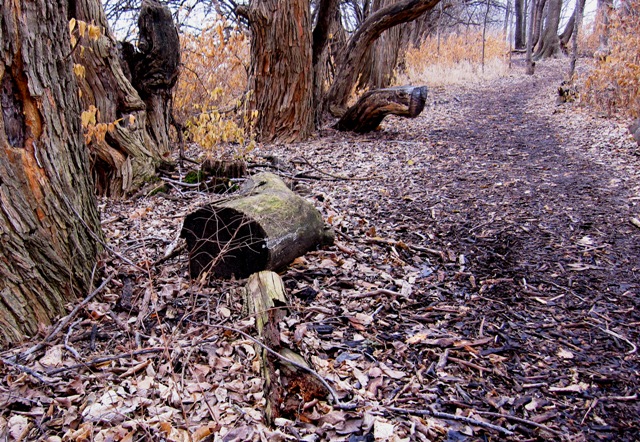
In the long days of winter, I encountered the beautiful golds of the prairie on my walk through the woods. I continue considering the importance of being present and reflecting. I recently read a good definition of what it means for us to reflect written by Dr. Daniel Siegel of UCLA in Mindsight. He says that the fundamental components of reflection are a tripod: openness, observation, and objectivity. Here is a summary of his definitions:     

Openness is the willingness to accept things as they are, without expectations and preconceived ideas about how we think things “should be”.     

Observation is our ability to watch our roles in events and our reactions to them; we are able to see how we fit into the context of life as we experience it.     

Objectivity allows us to have thoughts or feelings and not be had by them; we are able to see that our thoughts, feelings, beliefs are temporary.     

I like this analogy on many levels. In photography a tripod stabilizes a shot, giving it more clarity, detail, color, and shadow. In reflection, we can choose to be open, observant, and objective about ourselves, others, and our context. With the reflection tripod, we gain clarity, detail, color, and shadow about events around us and our role and reactions to these events. Reflection can give us distance and freedom to choose our actions and reactions. We can turn off our internal autopilot and change our behaviors, which leads to the possibility of change in our organizations and relationships.

Action precedes transformation; take time to reflect.   

Sand Creek Reflection

Things we don’t see

Prairie Hoar Frost II

This past week I took a number of photos when a hoar frost settled on the Kansas prairie. Since then I’ve been reflecting on this photo:

Prairie Hoar Frost III

In the photo is a beautiful red farmstead. I drive past this scene several times each week, but I have never noticed it before. The fact is that I have seen it, I just haven’t noted the obvious.

Whether driving in the car, walking in the woods, drinking tea with friends, or leading an organization development project, I continue to challenge myself to be present and aware – to see things I don’t see.

Why we’re happier on Saturday

I was intrigued to see research stating that we are happier on the weekends. This seems intuitive to me. But the research is instructive. We’re happier because we spend our time doing things that we are internally motivated to do, setting our own schedules, and relating with people we feel connected to.

For those of us who are interested in improving organizations, this relates back to my post about ending management as we know it. Research continues to challenge us to create workplaces that support autonomy and control over what, where, when, and how we do our tasks. When people are motivated to work because they want to contribute and increase their mastery of the task, effectiveness and efficiency increase.

Some would argue that their workplace can’t permit autonomy and allow people choice over what, when, how, and with whom they work. I will concede this point. But I will continue to argue that even if a given workplace requires stringent quality controls, opportunity remains.

In those cases (hospitals and air traffic control come to mind), the opportunity for management is to support employees in gaining mastery – to get better and better at what they do. The other opportunity is to clearly and regularly communicate why what employees are doing matters – that the purpose is in service of the larger common good.

As our organizations continue to wrestle with constructive ways of changing management practices toward evidence-based practices, let us all enjoy the weekends ahead!

Scrambling cognitive eggs

The Learning Organization has been a buzz word in companies since MIT’s Senge published The Fifth Discipline in 1990.  Yet organizational learning can happen only when individuals in the system learn. And, in most organizations, the individuals in the system are adults.

In my last post I talked about the ways that our brains continue to grow and change throughout our adult lives. There are implications for adult learning environments. Adults work primarily with concepts and patterns, not facts. If we want adults to learn facts, it’s best to introduce the information in small amounts followed by a question, “How does this fit or not fit with what you already know?” Followed by more questions for reflection:

How does this change your view of the way things work?
What do you agree with?
What do you disagree with?
What new patterns do you see when you consider the new information?
Does this make you think of a story or something you’ve experienced?

Those who already practice critical thinking may recognize some of these questions. Critical thinking and reflection are what allow adults to learn, to grow new neurons, to lay down new neural pathways and reinforce old ones. Shaking up our cognitive pathways allows us to continue to learn and grow . . . allowing our organizations to be learning organizations. Let’s make sure our learning opportunities are appropriately scrambled and not all in one basket.

Cracking the cognitive egg

Researchers continue to describe new findings on the human brain. Long-held beliefs are changing as we learn that our brains continue to form new neurons and connections throughout our lives. I can see applications in organizations for the information being uncovered. From education and training to relationship building and communication, our brains impact how we function and learn.

One of the areas that intrigues me is how I can stimulate my brain to grow and change, to create new neurons and new memory pathways. Dr. Kathleen Taylor suggests that as adults we should focus less on adding to our storehouse of facts. While information is important, a brain tune-up requires that we move out of our comfort zone. Talk to people we normally bypass. Go to lunch with someone who sees things differently. Drive a different route to work. Read a book from a less frequented section of the library or bookstore.

The good news is that as we age, our brains are more likely to see patterns and integrate what we learn into the neural system. The challenge is to take action to continue building our individual system so that we can effectively contribute to the bigger systems to which we belong. So, here’s to scrambled neural pathways and cognitive development …!

Getting outside of the box

How often have you heard the request, “We need to think outside of the box.”? At the start of the new year, we traditionally pause to reflect and set new goals. But how many of the goals from last year do we even remember?

As I considered this dilemma, I was challenged to get “outside the box” and do a thought experiment by Ron Ashkenas, a blogger at HBR. He suggested firing myself and reapplying for my job. Here are his questions that I asked myself along with a couple of my own:

What are your qualifications?
What would you say in an interview about the changes you would make and the improvements you would engineer?
What unique “stamp” would you put on this new job?
How do you feel about the business strategy and the quality of the leadership team?
What would you change?
What are your strengths? What will you do this year to grow and increase your strengths?

While this is not at the level of the thought experiment that allowed Einstein to come up with e=MC2, the experiment allows me to challenge myself and survey the organizational landscape around me in a different way.