Skip to content

Resource: Organization Development Processes

I’ve collected more than a few classic Organization Development resource links over the last several years. If you are just getting started in the Organization Development field or are looking for on-line resources to lead your own process, here are resources that I’ve found useful (in alphabetical order):

Appreciative Inquiry Commons 
Balanced Scorecard Institute 
Future Search 
Open Space Technology Links from Peggy Holman 
Society for Organizational Learning 
World Cafe: Juanita Brown and Tom Hurley 

And, links to past posts of resources:

Resource: Harvard Business Review 
Resource: Leader to Leader Institute 
Resource: Organization Development resources on the web 
Resources for Positive Organization Development 

Visual meetings

Tom Wujec gave a short  TED talk: 3 Ways the Brain Creates Meaning. His point is, “We make meaning by seeing.” Here is a summary of how the brain makes meaning with the brain subsystem activated in parentheses:

  1. Use images to clarify ideas. (ventral)
  2. Interact with images to create engagement. (dorsal)
  3. Augment memory with persistent and evolving views. (limbic) 

Using images to create shared mental models leads to better communication, learning, thinking, problem solving, and collaboration. He uses Visual Strategic Planning as an organizational example of the idea that we are all visual developers and learners.

As I consider what this information means for organization development, I go beyond his example to considering how we run meetings, communicate information, and deliver training. How can we increase the visual component of what we do in order to increase the building of shared mental models and shared meaning?

Uncertainty as opportunity

Waiting for the Winter Wheat

In Kansas, the winter wheat is planted. We watch and wait for it to emerge, wondering if the weather will support its life. We wonder – and all the while every human being is born with a preference for predictability. We want to know when and where we will sleep and eat. We are most comfortable with people who are like us. We learn more when we are given an agenda or syllabus that tells us what’s coming. Yet life remains uncertain; we can’t control everything or get all of our questions answered.

In our organizations we like certainty too. We create five-year plans, develop key performance indicators, and post weekly metrics on the bulletin board in the cafeteria or coffee area. Yet, here too, the unexpected and uncertainty continually get in the way. Or do they? What if we changed our perspective, paradigm, assumptions, or way of seeing?

As organization leaders and organization development practitioners, our role is to engage uncertainty, to engage what is emerging. I’ve used the Appreciative Inquiry and Open Space Technology processes to successfully engage organizations and individuals in emerging possibilities. As often as I’ve used these processes, I’m still amazed at the unexpectedly innovative and surprisingly positive outcomes – ones that could not have been imagined when we started.

Peggy Holman, coauthor of The Change Handbook, suggests that when we engage emergence, we become more inspired to pursue things that matter, form new connections with other people, and create new possibilities. The challenge is choosing to engage the disruption, chaos, and upheaval rather than spending our energy trying to fix and maintain the existing system. Practical questions for engaging the possibilities in uncertainty:

  • What is most important?
  • Given the unexpected circumstances, what is possible now?
  • Given the broken process, what would it look like if it were working successfully?
  • What could we do together as a team that we can’t do by ourselves?
  • What would you most like to do?

As for the future, your task is not to foresee it, but to enable it.
 –
Antoine de Saint-Exupéry, The Wisdom of the Sands

Weekends are for different perspectives

Fall Morning at Selzer Barn

Selzer Weathervane IV

Fall Hedge Apple

2010 Fall Flower

What did you take time to observe this weekend? How did it shift your perspective? Or, are you so busy rushing through the world that you’re “blindfolded”? 

For further reflection:
Things we don’t see
Walking in the woods and Organization Development

TED commandments and public speaking

TED is in the news with its new Global Conversation. But beyond the ideas worth spreading concept, are sound public speaking ideas. Here are the 10 commandments of TED talks:

  1. Dream big.
  2. Show us the real you.
  3. Make the complex plain.
  4. Connect with people’s emotions.
  5. Don’t flaunt your ego.
  6. No selling from the stage!
  7. Feel free to comment on other speakers’ talks.
  8. Don’t read your talk.
  9. End your talk on time.
  10. Rehearse your talk in front of a trusted friend … for timing, for clarity, for impact.

Garr Reynolds gives his version of the “TED commandments” with additional comments on preparing to speak. He offers examples of speakers who presented data heavy information, used a script, and one who stood, planted behind a podium. The point is that all of these people found a way to deliver ideas worth spreading that engaged the audience through their use of story and compelling delivery.

If you’re already a TED fan, I recommend the article in September Fast Company that was forwarded to me by a friend this week: “How TED Became the New Harvard – Only Bigger“.

As for me, I appreciate the work that has been done in the last several years to encourage improvement in the delivery of business, technical, and general presentations. I always find room for improvement whenever I reflect on my own public speaking opportunities. Re-reading the TED commandments is a good place to begin.

Idea for reflection – 21

The world is full of answers. If you ask a simple question, you can get a million of them, no problem. In fact, think of how many conclusions we reach each day: think about all of our likes and dislikes, our views about the world, who we think we are, and who we decide we want to be. But have we ever been able to reach a point of absolute certainty about anything?
  – Elizabeth Mattis-Namgyel, The Power of an Open Question

Idea for reflection – 20

Fall freeze

The days are getting shorter, and my to-do list is getting longer. In the last week, I’ve talked with several people who feel stressed and overwhelmed. Indeed research shows that our first reaction to stress is fight, flight, or freeze. This reaction happens in a microsecond in the limbic region in our brain – before we are even aware of it.

Over time, with enough stress, we can start defaulting to freeze, to being  just plain overwhelmed. This goes by many names, analysis paralysis, choking under pressure, or worry.

So here are a few strategies that I use to get “unfrozen”:

  • Create a status list. Start with a checklist or to-do list and briefly outline status, timeframe, and next steps. This frees up working memory, allowing better processing of tasks at hand.
  • Outsource what you can. Instead of trying to “do it all yourself” find items that can be managed by others. Letting go of control offers others the opportunity to develop and frees energy for focusing on where your time is needed.
  • Take a break from the computer and cell phone. Go for a walk. Taking a pause from the things that consume you allows for incubation, a fresh perspective. Exercise or just time away can allow our neural pathways to make new connections, allowing new patterns to become apparent.
  • Modify thoughts and reactions. Accept things as they are, without expectations and preconceived ideas about how we think things “should be”. Observe our roles in events and our reactions to them. Remember that our thoughts, feelings, beliefs are temporary.

My goal is to live successfully with stress, not frozen, not rushing ahead for more of the same – engaged in getting unfrozen and enjoying the seasons of life around me. How do you get “unfrozen”?

Have you played today?

Check out Deborah King’s post today on play. She offers a detailed review of the book, Play: How It Shapes the Brain, Opens the Imagination, and Invigorates the Soul. She reflects:

We all realize the world is a much more complex place than it used to be.   Solving the problems our businesses are facing requires viewing the problem through different filters, and being open and innovative to try things we haven’t tried before.  Research indicates that play can be the key to improving our abilities to work collaboratively in a process of fact-finding, brainstorming, and innovating solutions.

Exploring the idea of “play” in the workplace can help us create the future.

Stories that resonate

Nancy Duarte’s new book, resonate (sic), landed on my porch yesterday. A quick read-through showed that in the new book, she is building on her work in slide:ology (sic). The main point? Even a well designed PowerPoint or Keynote slide will not connect with the audience unless the speaker has a compelling story to communicate.

The book delivers a review of story design techniques. I appreciate the case studies and process descriptions that make the material practical. Even more importantly she asks each person to reflect on how and why they communication (p. 216):

Passion for your idea should drive you to invest in its communication.

I have experienced first hand the power of story to connect people and groups, to form networks, and to create something that didn’t exist in the past. This book is worth reading if you want to consider how you communicate – whether or not you stand in front of a group to do it.

Stories with Wings
Goldberg’s Rule
ru comunic8N?

Idea for reflection – 20

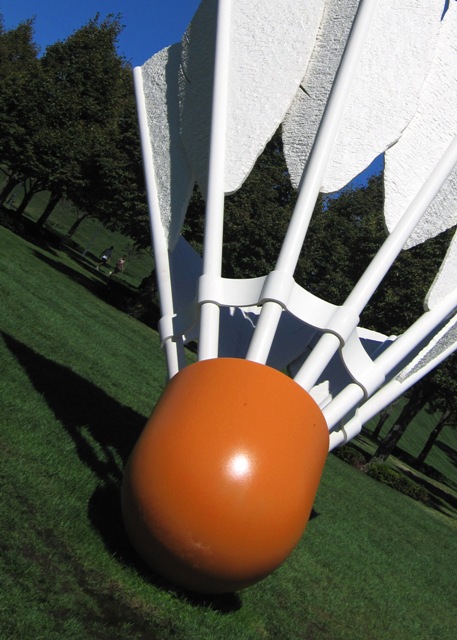
Shuttlecock V

Life is about
not knowing,
having to change,
taking the moment
and making the best of it
without knowing
what’s going to happen next.
  – Gilda Radner 

Idea for reflection – 19