Idea for reflection – 24

The world can only be grasped by action, not by contemplation. The hand is the cutting edge of the mind.
– Jacob Bronowski, from The Ascent of Man
– Jacob Bronowski, from The Ascent of Man

Nov 8
During our last two adventures to Quivera National Wildlife Refuge, I’ve taken many photographs of reeds and marginal plants. My goal is to seek the best representation of the plant and wait for the best light to highlight the subject.
It’s easy to do the same thing in organizations: to seek the best opportunity and the best time to act. Paralysis can set in while endless analysis and evaluation are done. Meetings without outcomes support the paralysis. Inertia takes over. It becomes simplest to do nothing.
Some might like to put the focus on “leadership”, expecting them to create movement. Yet each person in the system has a responsibility to act and contribute. Nor am I suggesting that we settle for marginal, neither the best or the worst.
But perfection paralysis leads directly to average and the “do nothing” doldrums. Today, choose to act and make decisions, to finalize processes or project steps – even when somewhat less than perfect. Encounter the freedom of good enough, the joy of letting go, and the power of moving forward.
 A student asks, “What do I have to do to get an ‘A’?”
A child in the backseat asks, “Are we there yet?”
An employee asks, “Can we check that off now?”
I am a logical, linear thinker. Getting good grades, arriving at my destination, and checking things off my
to-do list get my adrenaline flowing. Yes, focusing on the results can lead directly to the desired outcome, but it can obscure obstacles along the way. Single-minded focus may produce the desired outcome, but diminish the serendipity that comes from exploring. So, how might I reframe my focus?
Am I learning the material, applying it, and integrating it into my work and practice?
Am I enjoying the moment as the beautiful fall leaves pass by the car window?
Am I reviewing the process to determine if it is serving the values and goals of the organization?
For further reflection, “Can I describe an effective process that produces results and desired outcomes while providing for awareness of obstacles and unexpected opportunities?”
Oct 17
In the last week I’ve talked with two organizations that are stuck inside of processes that were designed to be a way to move forward. I’ve met with people who are tired, tired from working too many hours, even though they love their work. And for the most part, my blog has gone silent as I’ve been stuck in the round of daily work and family responsibilities. With technology creating the tyranny of the immediate, I find it easy to work 8 to 10 hours in my home office without noticing much of the world around me.
And so – I’m being intentional about getting my self unstuck first. My rule is that one can’t assist others in getting unstuck if you are already immobilized. Here is where I started:
I got out of my office chair and walked out the front door. I experimented with the macro setting on my camera.
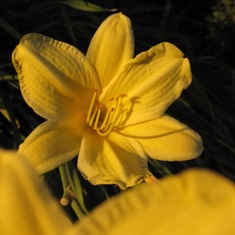
Daylily 10.15.2010
I read articles in magazines and books; yes, the paper kind that you hold in your hands. I not only read through organization development (OD) material, I read material wildly outside of the OD discipline: architecture design, theology, photography, and writing. And I temporarily relocated my office to the back porch.

Back Porch Office
I went on an adventure with my husband to Quivera National Wildlife Refuge.

Quivera NWR Sunset 10.16.2010
I talked with an old friend and made plans for an in-person visit. …I’m moving toward “unstuck”.
In her post titled, A Perfect September Day, Shirley Showalter challenged her readers, “What does your perfect day look like? If you haven’t had one lately, describe it here; then go make it happen.” What do you do to get unstuck, discover life outside the office and away from technology, renew your spirit, and re-discover the quest for possibilities? I’ll repeat Shirley’s admonition, “describe it; then go make it happen.”
 WORKING TOGETHER
We shape our self
to fit this world
and by the world
are shaped again.
The visible
and the invisible
working together
in common cause,
to produce
the miraculous.
I am thinking of the way
the intangible air
passed at speed
round a shaped wing
easily
holds our weight.
So may we, in this life
trust
to those elements
we have yet to see
or imagine,
and look for the true
shape of our own self
by forming it well
to the great
intangibles about us.
– David Whyte,
from River Flow
(Written for the presentation of The Collier Trophy to The Boeing Company marking the introduction of the new 777 passenger jet.)

Skyscape XIII
Do not depend on the hope of results … you may have to face the fact that your work will be apparently worthless and even achieve no result at all, if not perhaps results opposite to what you expect. As you get used to this idea, you start more and more to concentrate not on the results, but on the value, the rightness, the truth of the work itself … gradually you struggle less and less for an idea and more and more for specific people …. In the end, it is the reality of personal relationships that saves everything.
– Thomas Merton, from The Letters of Thomas Merton

Fall Morning at Selzer Barn
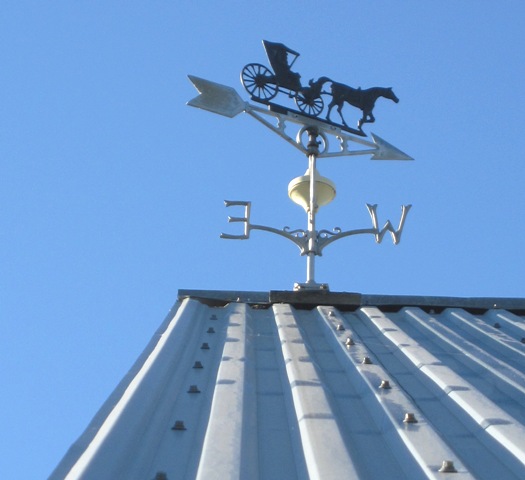
Selzer Weathervane IV
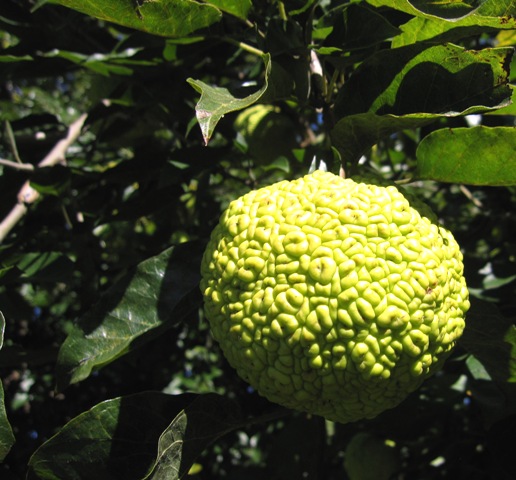
Fall Hedge Apple

2010 Fall Flower
What did you take time to observe this weekend? How did it shift your perspective? Or, are you so busy rushing through the world that you’re “blindfolded”?
For further reflection:
Things we don’t see
Walking in the woods and Organization Development
TED is in the news with its new Global Conversation. But beyond the ideas worth spreading concept, are sound public speaking ideas. Here are the 10 commandments of TED talks:
Garr Reynolds gives his version of the “TED commandments” with additional comments on preparing to speak. He offers examples of speakers who presented data heavy information, used a script, and one who stood, planted behind a podium. The point is that all of these people found a way to deliver ideas worth spreading that engaged the audience through their use of story and compelling delivery.
If you’re already a TED fan, I recommend the article in September Fast Company that was forwarded to me by a friend this week: “How TED Became the New Harvard – Only Bigger“.
As for me, I appreciate the work that has been done in the last several years to encourage improvement in the delivery of business, technical, and general presentations. I always find room for improvement whenever I reflect on my own public speaking opportunities. Re-reading the TED commandments is a good place to begin.
Sep 30

The world is full of answers. If you ask a simple question, you can get a million of them, no problem. In fact, think of how many conclusions we reach each day: think about all of our likes and dislikes, our views about the world, who we think we are, and who we decide we want to be. But have we ever been able to reach a point of absolute certainty about anything?
– Elizabeth Mattis-Namgyel, The Power of an Open Question
The days are getting shorter, and my to-do list is getting longer. In the last week, I’ve talked with several people who feel stressed and overwhelmed. Indeed research shows that our first reaction to stress is fight, flight, or freeze. This reaction happens in a microsecond in the limbic region in our brain – before we are even aware of it.
Over time, with enough stress, we can start defaulting to freeze, to being just plain overwhelmed. This goes by many names, analysis paralysis, choking under pressure, or worry.
So here are a few strategies that I use to get “unfrozen”:
My goal is to live successfully with stress, not frozen, not rushing ahead for more of the same – engaged in getting unfrozen and enjoying the seasons of life around me. How do you get “unfrozen”?


 Friesen Group