Skip to content

The naked presenter

At first glance, Garr Reynolds’ new book, The naked presenter, is another entry in the “how to deliver presentation” genre. But as I read through the book, I found myself making notes. The notes were not about how to improve my presentations, but about how I approach change management.

As an organization development practitioner, I spend my time working with change management. This morphs through training – to teach something new, facilitation – where knowledge and ideas are exchanged,  and, communication – designed to inform, motivate, and effect behavior change. Reynolds writes about all of this and more. He integrates information from interpersonal neurobiology, personal observation of his surroundings, and jazz musicians.

He does write about making effective presentations and improving public speaking skills. But the most important idea I encountered in the book is that “lessons are everywhere.” It is up to each of us to inquire into everyone and everything we encounter, asking how it impacts who we are and what old and new lessons we take away.

Each of us has many opportunities to connect with others. Knowing who we are and what matters is the foundation. Knowing why we are speaking, along with how and what we are communicating, allows us to build and effect change.

If you like to walk around the neighborhood block backward, seeing the roof lines and landscape from a new perspective, I recommend reading this book and watching for patterns that reach far beyond presentation design.

Who are you becoming?

This past weekend Jon and I went on an adventure to Squaw Creek National Wildlife Refuge. A decade ago, I used to make an annual pilgrimage to the refuge every December for their Eagle Days celebration. The time there brought back wonderful memories of friends and the experiences we shared. It was a reminder that it is important to choose how I spend my time.

Daniel Pink recently asked a similar question, “Is what I’m doing right now going to be of lasting value to me or to others?”

In my world, time gets consumed online in-between meeting after event after meeting all while texting to keep business and family schedules synced and moving. The reality is that I’m riding along on the wave and taking my family and business along for the ride. What I choose directly influences who I become and what lasting value I create.

It’s time to stop and ask the question, “Is what I’m doing right now going to be of lasting value to me or to others?” And, then reflect on how I am choosing to use my time.

And yes, we saw over 30 eagles.

Needed: more data or the right question

Here’s a quote I’m turning around and looking at from all directions today:

The most important maxim for data analysts to heed, and one which many statisticians seem to have shunned, is this: Far better an approximate answer to the right question, which is often vague, than an exact answer to the wrong question, which can always be made precise…
  – John Tukey

The key is finding the right question.

Idea for reflection – 26


A great piece of art is composed not just of what is in the final piece, but equally what is not. It is the discipline to discard what does not fit—to cut out what might have already cost days or even years of effort—that distinguishes the truly exceptional artist and marks the ideal piece of work, be it a symphony, a novel, a painting, a company, or most important of all, a life.
  – Jim Collins

A stop doing list
Idea for reflection – 25

Developing leaders

I’ve been talking with another organization development practitioner about a company that is seeking to develop leaders by developing a program based on “leadership competencies.” To that end, the organization is spending time creating a list of desired traits and abilities, which will then be formed into a training curriculum. And yet, how do you choose what traits will be most valued? Decisive or Flexible. Intuitive or Prudent. Disciplined or Compassionate? Persistent or Creative? Confident or Humble?

Another organization is working to develop leaders by building on strengths. While I will agree that strengths are important, there is a shadow side to strengths. For example, persistence can lead to controlling others, creativity can lead to never finishing anything, or decisions based only on data can lead to unethical actions.

So how do we develop leadership? I would argue that anyone can improve their leadership abilities if they are open to feedback and learning, change and growth. I have been coaching several managers who want to become better leaders. They are learning by getting feedback from their teams and making changes in their communication patterns and other behaviors. They know their strengths, but are not defined by their strengths or their weaknesses. They are willing to bring their whole self to work: skilled and inexperienced, disciplined and compassionate, confident and vulnerable. In return, they are respected and trusted by their teams.

Yes, it is important for managers to have the skills and training to do their jobs effectively and efficiently. Yet in my observations, anyone who is willing can lead from where they stand – without regard to rank, position, or title. The most successful leaders know and accept themselves for who they are now and seek to learn and improve. They are willing to live with the paradox that seemingly opposite traits are all needed at the appropriate time and place.

Measuring leadership success

Meeting of the minds

Flint Hills - Storm at Sunset

I like “clicking” with people in conversations – where it’s almost as if our brains are playing leap-frog. It’s fun being in sync. Now, new research from Uri Hasson of Princeton, highlighted in this month’s Harvard Business Review, demonstrates that successful communication results in a biological “meeting of the minds.”

With speaker and listener connected to functional MRI (fMRI) machines, the researchers demonstrated that the speaker’s brain and listener’s brain scans displayed widespread overlap or mirroring. Using follow-up comprehension assessments, they showed that neural mirroring increased as comprehension increased. When listener’s comprehension was highest, the listener’s brain activity appeared slightly before the speaker’s activity – meaning active listeners were able to anticipate what would be communicated next.

While this study was done without face-to-face communication (the subjects were inside of scanners), the researchers propose that face-to-face communication would create even stronger neural coupling. This due to the fact that mirror neurons discharge both when performing an action and when observing an action. Interestingly, neural coupling does not occur when hearing foreign languages spoken.

Speaking and listening are a shared function of two brains. Since reading these articles, I’ve been reconsidering effective communication. How do we work to intentionally use language patterns and words that are most likely to create neural mirroring and increase comprehension? In an organization or educational setting, how important is an agenda or pre-work for laying a common foundation for enhancing communication?

How does this impact your ideas about communication? What are the practical things that help you to be “in sync” in a conversation?

Digesting experience

The long weekend has brought Thanksgiving meals with family and friends along with opportunities for walks in the woods.

In life, we constantly experience interactions with people and environment. Whether at home or in our organizations, we take in what is happening around us. It’s easy to let encounters, emotions, and memories accumulate. We hold on to our experiences – good, bad, joyful, and difficult.

When we eat food, our bodies process it, taking what is needed for life and energy, eliminating the rest. We do not struggle to digest food; it’s a natural process. What if we digest experience the same way? Observing and reflecting on what happens with the intention of embracing what is life-giving. Choosing to let go of what is not needed or energy draining.

What would we learn and embrace? What would we let go of? How would we and our organizations change?

Fetzer Institute – Tools for Changing Everything

A little imagination

… can take the lowly hedge apple

Fall Hedge Apple

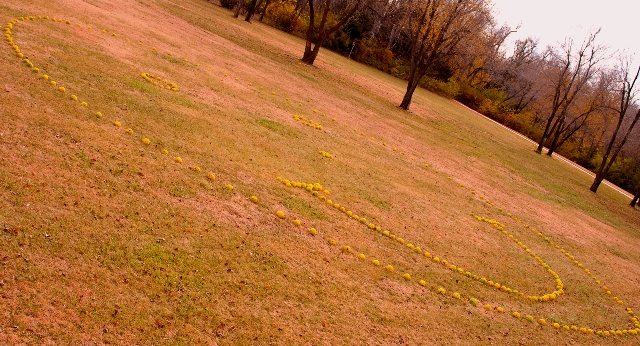
… and create a work of art:

Hedge Apple Smiley Face

Thanks to the neighborhood kids and their creativity!

Where is your imagination taking you?

Creativity

All children are artists. The problem is how to remain an artist once he grows up.
  –Pablo Picasso

How do you experience individual moments throughout the day? Do you see what is around you? Do you incorporate what you see into your ideas and opinions? Do you let it move you? Is it fun!? Here are some things I’ve seen in the last three days:


Getting unstuck

Idea for reflection – 25


When you improve a little bit each day, eventually big things occur. Don’t look for big, quick improvement. Instead, seek small improvement one day at a time. That’s the only way it happens–and when it happens, it lasts.
  – John Wooden
 
 
Idea for reflection – 24