Skip to content

Posts from the ‘Kathleen’ Category

kaizen

The Japanese word, kaizen, is often translated as continuous improvement. A more literal translation is change (kai) better (zen). Continuous change happens while taking one step at a time into the future. Continuous – meaning that we never arrive at perfection, but steadily work to improve. Matt May describes the kaizen steps using the acronym IDEA: “Investigate, Design, Experiment, Adjust.”

I’ve been reflecting on the power of combining kaizen with Appreciative Inquiry. Together they create a unique process for organization development. Appreciative Inquiry (AI) asks us to investigate, inquire, and discover what is working well. It asks us to imagine and design next steps. Then, without conclusion, AI cycles to delivering results and back to renewed inquiry. Adding the “Experiment” from IDEA into the process, improves and strengthens the design by asking us to innovate using design thinking.

AI opens a conversation with every level of an organization. It builds on existing resources and strengths, creating possibilities. I’ve seen managers surprised by the energy and ideas coming from within their team. I’ve seen departments shift their focus, creating entirely new opportunities and practices. I’ve seen large systems discover ways of engaging across formerly impermeable boundaries. I’ve seen individuals take steps toward personal goals. Appreciative Inquiry is an effective framework for kaizen and organization development.

When and how have you experienced kaizen? What processes do you use to support “change better?”

Grown-up play

Napping Jayhawk

This photo was taken yesterday afternoon at an event where people of all ages engaged in creativity, play, and community building: a soup challenge fundraiser. This Jayhawk puppet belonged to a 5-year-old who thought that the Jayhawk needed a nap before the event kicked off. We had fun from beginning to end!

Garr Reynold’s has an interesting post on play. Here’s an excerpt:

As very young children, we were naturally authentic communicators and conversationalists. But then somewhere down the line we began to be guided away from that natural, human talent as a shift occurred in our education that emphasized “the correct answer” and demanded careful, formal speech—speech that did not encourage engagement and dissuaded our true personalities from coming out, lest we run the risk of ridicule. But you are an adult now and you can change your destiny. You can find again that naturalness, creativity, and energy you had as a child and combine it with your knowledge, skills, and passion to make real human-to-human connections that lead to remarkable change.

I’m considering how authentic action leads to genuine connections and on to “remarkable change.” As an organization development practitioner, I work with many organizations and individuals in transition – another word for change. How do I bring meaningful play into my work with clients? How do I combine the freedom and energy of play with my skills? How do I build, and lead others to build, relationships that are life-giving?

May we all discover relationship and creativity, finding the “napping Jayhawk” right next to us, leading to “remarkable change.”

Have you played today?
Time to play

Wanted: Experience

In recent job interviews, a just-turned-30 acquaintance has been rejected for lack of experience. Additionally he is often told that older persons already in the hiring organization wouldn’t be comfortable with a younger leader. And yet, he has kept a sense of humor, sending me an e-mail with this subject line: “How to sound younger in an interview.”

Having worked with this person on multiple projects in a variety of settings, I have come to appreciate his creative ideas and insights. I have seen him work successfully with people of all ages. On more than one project, his leadership led to changes that could not have been imagined by someone embedded in the system for the past 10 or 20 years.

I have worked with and supervised persons younger than me, and in turn, been supervised by younger persons. In all of these relationships, I have benefited from younger persons’ thoughtful leadership and management abilities. I have learned to see the world and organizations in different ways, to see my role and my self in new ways.

I value the contributions of all persons, no matter their age, in the organizations where I participate. If your organization is tied to a particular map of how the world works – i.e. older persons always supervise younger persons, I challenge you to adventure to the map edge and discover the power and opportunity of experiencing the extra-ordinary.

Ready, set, action

Motionless swings at the park waiting for actionDiego Rodriguez says, “In doing there is knowing.  We learn via our mistakes, and we make many more mistakes of value when we take action.”

It is not enough to know what to do, we must act. It is not enough to do Strategic Visioning, we have to implement. It is not enough to do Executive Coaching, the individual and the organization must choose to change and adapt together.

Long-time readers know that I encourage reflection and time to think. But there is balance between reflection and action. As we approach the end of the year, where do you find your organization on the pendulum swing between reflection and action? What goals have been accomplished and celebrated? What are your dreams for the coming year? What actions can you take today that will lead to knowing and more action?

Idea for reflection – 24

The world can only be grasped by action, not by contemplation. The hand is the cutting edge of the mind.
  – Jacob Bronowski, from The Ascent of Man
 

Respect for historic context

I recently had a conversation with a friend who is interviewing for a job. The recruiter sent a job description in advance of the interview. It included the requirement that the employee be “respectful of the historical context” of the business.

This requirement certainly falls outside of standard job descriptions or traditional work task analyses. As we pondered the requirement, we decided that the ability to understand the historic context and the core values of an organization belongs in every job description. As Jim Collins says in Good to Great, “Preserve the core and stimulate progress.”

“Stimulating progress” and innovation are the business imperatives of the moment. So, what does it mean to “preserve the core”, to respect historic context? How do we honor the best of what presently is? Do our organizations tell the stories of the company founders, stories that demonstrate their values, hopes, and dreams? Do we tell our own stories of why we came to work where we do and what matters most to us about the people and customers we work with? Do we see pictures, awards, certificates, or other memorabilia that make visible past organization experiences and successes?

How do we connect the past to the future? What practical methods have you used or encountered to demonstrate honor and respect for the historic context?

Overheard conversation

While waiting for my meal this evening, I overheard this conversation between two restaurant employees:

“You missed the meeting,” said Employee One.

“So tell me what happened at the meeting!” replied Employee Two.

“It was the same meeting we had last week, and the week before that … nothing new.”

<and the work went on>

Do you have meetings that matter?

Perfection paralysis

During our last two adventures to Quivera National Wildlife Refuge, I’ve taken many photographs of reeds and marginal plants. My goal is to seek the best representation of the plant and wait for the best light to highlight the subject.

It’s easy to do the same thing in organizations: to seek the best opportunity and the best time to act. Paralysis can set in while endless analysis and evaluation are done. Meetings without outcomes support the paralysis. Inertia takes over. It becomes simplest to do nothing.

Some might like to put the focus on “leadership”, expecting them to create movement. Yet each person in the system has a responsibility to act and contribute. Nor am I suggesting that we settle for marginal, neither the best or the worst.

But perfection paralysis leads directly to average and the “do nothing” doldrums. Today, choose to act and make decisions, to finalize processes or project steps – even when somewhat less than perfect. Encounter the freedom of good enough, the joy of letting go, and the power of moving forward.

Resource: Steal this idea

Prairie Sunset with Hedge Row

I’ve written before about design thinking as an evidence-based process. Now comes a new post by Tim Brown of IDEO with links to downloadable books and resources from OpenIDEO. These resources demonstrate the IDEO method of design thinking. The method integrates ideas generated through a wide variety of networks, created through disciplined collaboration, allowing concepts to emerge and leading to actionable outcomes.

If you’re looking for ways of engaging emergence, I recommend discovering these free resources.

To challenge your thinking about emergence, read Tim Brown’s ideas and questions about “emergent characteristics” of successful regions that generate “relevant innovations”.

Running the race set before us

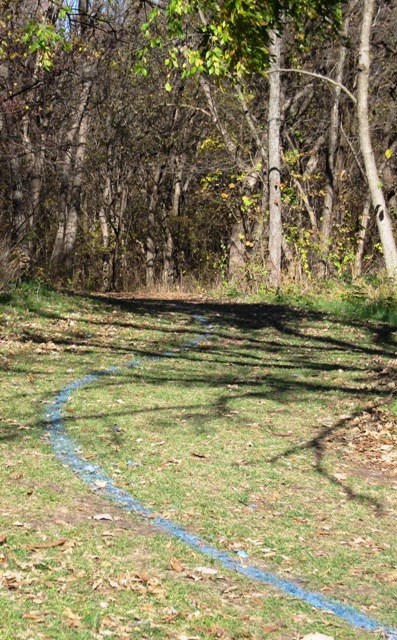
Blue Line on the Race Course at Rim Rock

Yesterday we were at the State Cross Country Meet at Rim Rock Farm in Lawrence. Everyone was being measured by their speed. Measured against other runners and against their personal records. I was standing at the 2 mile mark for the boys 5 kilometer race. (The challenge of mixing measurement systems is beyond the scope of this post!) The first runner in the 5A level boys race, flew passed me at the 10:10 mark, having already mastered “suicide hill”, headed for the final uphill push to the finish line.

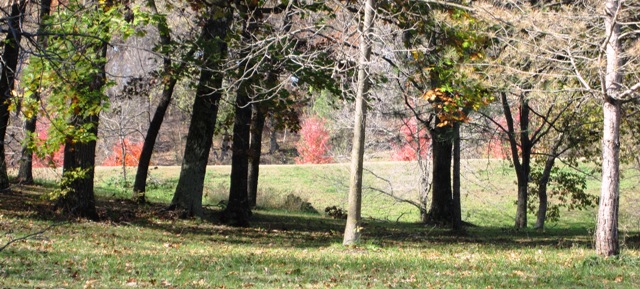
As I walked back to the gathering point at the race conclusion, I passed through a woods with a glimpse of maples dressed in fiery fall color.

Maples at Rim Rock I

Intrigued, I turned aside and discovered this vista:

Maples at Rim Rock II

In the midst of competition with others and self, with data being analyzed in every way possible, I paused to reflect. It has become hard to resist measuring everything. After all, we can collect tons or kilograms of data and analyze it in hundreds of different ways. It is easy for information to be lost in a sea of data. In the end, what will matter is whether the information can be identified, turned into knowledge, and acted on – used by each of us and our organizations to support and execute a successful, ongoing strategy.