Skip to content

Posts tagged ‘Organization Development’

Close up

How does your organization look at close range? Looking in from the outside, at a distance, everything can look perfect. It’s the “grass is greener on the other side of the fence” model. Mid-September is a good time to stop and assess closely:



  • Where have we come this year?
  • What factors have influenced our decisions and direction?
  • Who has impacted our organization from inside? From outside?
  • What is the objective we want to hold front and center between now and the end of the year?

What are your observations as you look close up?

Goldberg’s Rule

In Thinking in Time: The Uses of History for Decision-Makers, Neustadt and May* tell about their encounter with Avram Goldberg, CEO of Stop and Shop in New England. He told them that his approach to problem solving is, “When a manager comes to me, I don’t ask him, ‘What’s the problem?’ I say, ‘Tell me the story.’ That way I find out what the problem really is.”

Once the story is told, it’s time for the conversation participants to use critical thinking skills:

  • Use the reporter’s checklist for inquiries: who, what, why, when, where, how, with what effect?
  • What is the story advocating and assuming?
  • What is the central concern or challenge and the corresponding opportunity?
  • What is the history of the situation? Who are the key players? How have they interacted through time?
  • What new facts, if presented, would cause you to change your assumptions, direction, or decision?

Beginning with a story and following with these clarifying questions works can develop a deeper awareness of the factors influencing the situation at hand. Collaborative conversations that look deeply at a situation allow for learning and good decision-making. And, beyond improving performance, research by Dr. Richard Boyatzis* from Case Western Reserve University demonstrates that leaders who spend time coaching and mentoring others reduce their own stress levels.

*Neustadt and May, p. 106.
*Boyatzis, R. E., Smith, M. L., Blaize, N. J. (2006). Developing Sustainable Leaders through Coaching and Compassion (pp. 8-24). Academy of Management Learning and Education.

The view from the middle

When I start a new project, all of the possibilities are ahead, full of energy and potential. The plan is pristine. The strategy carefully laid out. Then the hard work begins. And the hard work is interrupted by other projects, telephone calls to return, lunches to review other projects, and on … and on. Some of these interruptions are deadlines that must be met to deliver on time, keeping the business on track. Others are necessary for building relationships and ongoing work.

Skyscape VII

I can get to the end of a day or week, look back, and feel as though I haven’t finished anything. I’m in the middle – a wilderness where uncertainty and ambiguity reign.

Rosemary Kanter’s line is, “Everything can look like failure in the middle.”  In the middle of the wilderness I encounter obstacles, discover my assumptions are faulty, and can be tempted to give up. If I give into this temptation, I automatically fail. It is up to me to find a path around or through the obstacles – to persist and preserver.

Churchill’s quote comes to mind, “Never give in.” While I’m in the middle, I’ll keep the faith. Afterall, life itself is a work in progress. I’ll believe in the process and look forward to living into the outcome.

Idea for reflection – 19

Grand Teton Thunderstorm

In a few hundred years, when the history of our time will be written from a long-term perspective, it is likely that the most important event historians will see is not technology, not the Internet, not e-commerce. It is an unprecedented change in the human condition. For the first time—literally— substantial and rapidly growing numbers of people have choices. For the first time, they will have to manage themselves. And society is totally unprepared for it.
  – Peter Drucker

Idea for reflection – 18

Did you pass Time Management 101?

Yes! I know how to make to-do lists. I schedule a specific time in my day to return telephone calls. I have my e-mail flagged for follow-up. I use my Blackberry to keep my Inbox cleaned out on evenings and weekends. Great! … but …

For all of our time management strategies, there are never more than 24 hours in each day. While we are busy trying to manage our time, it goes by apace. Everyone gets the same amount. The truth is:  Time is something outside of our control.

Is it possible that we need to stop trying to manage our time better and start managing ourselves? Try keeping a tally of how often you are distracted by another e-mail or text message. Or keep track of how many times you start a task only to take a phone call. Or tally how many times you postpone doing something you value like spending time creating a new work strategy, connecting with friends and family, or going on a walk. What if you intentionally disconnected for 30 or 60 minutes to focus on an important task or to have a significant discussion?

What if we stopped blaming our inability to manage time and started actively managing our selves?

The power of critical thinking

For one week at the end of July, we were privileged to be in Missoula, Montana where Jon attended a course at the Rocky Mountain School of Photography. Jon learned about photographic technique and composition. But every time someone asks him about the experience, his emphatic comment is, “It was the best educational experience I’ve ever had.”

If you know Jon, you know that he’s spent thousands of hours in the classroom, both sitting in the seats and teaching. Such a statement coming from him is significant. So the question is, “What made it so excellent?” His response, “They taught me to think critically about how and what I photograph.”

I’ve written often about the importance of critical thinking. Jon’s exceptional experience is personal confirmation of its value. Some of the critical thinking his instructor asked them to do:

  • What factors do you need to think about when approaching a scene?
  • Are you identifying things in the scene that would connect with the viewer?
  • What will you choose in composing and framing the shot that will draw the viewer into the experience?
  • How will you exploit the technology in your camera to contribute to a memorable photograph?
  • What speaks to you from out of this space?

The structure of the course included classroom lecture and demonstration, field photography, and group critiques of the field work. Exposure to new ideas and processes, followed by applying the new knowledge in the field with an instructor alongside facilitating critical thinking, and finally reflecting on and examining the results led to an exceptional learning experience.

Although only an interested bystander, I found it inspiring to watch growth and development happen for everyone who engaged in this course. I continue to consider how to best apply critical thinking when I facilitate learning opportunities. Can you recall an experience where critical thinking made a significant impact?

All the world’s a stage

All the world’s a stage,
And all the men and women merely players;
They have their exits and their entrances,
And one man in his time plays many parts.
  – William Shakespeare

How many roles have you played already this week? Boss. Cook. Parent. Spouse. Manager. Friend. Janitor. Child. Clear roles and responsibilities keep business processes and families running smoothly. Yet the paradox is that rigid roles and rules can cause processes to collapse and malfunction under changing conditions. Keeping the roles and responsibilities simple permits flexibility and adaptability when needed.

Understanding and acting out our roles and responsibilities requires a personal commitment to behaving with social intelligence. The phrase “social intelligence” has become “business speak”. I will define it as first having a personal understanding of ones own values and philosophy coupled with empathy and compassion for others  along with the ability to communicate effectively and influence others.

In other words, each of us is more than the hats we wear in any given situation, more than the job title, more than a relationship. If we seek to know and act on our core values and philosophy or way of being in the world, we can participate more easily in all of the different roles life offers us. If all the world is a stage and we are the actors, perhaps the key, as the airline flight attendants say, is to secure your own oxygen mask before assisting others.

Idea for reflection – 18


Many people are surprised to learn that in twenty-seven years at UCLA, I never once talked about winning. Instead, I would tell my players before the games, “When it’s over, I want your head up. There’s only one way for your head to be up, and that’s for you, not me, to know that you gave the best effort of which you are capable. If you do that, then the score really doesn’t matter, although I have a feeling that if you do that, the score will be to your liking.” I honestly, deeply believe that in not stressing winning as such, we won more than we would have if we had stressed outscoring opponents.
  – John Wooden 

Where are you investing?
Success … maybe
Idea for reflection – 17

Where are you investing?

This question is not about dollars. I’m asking about where you’re investing your time and energy? Do you set goals? Do you set the Jim Collin’s type of goals: Big Hairy Audacious Goals? I’m not opposed to goals and objectives, but I would argue that we too much time being invested in achieving the outcome.

We invest a lot of time and energy into desired outcomes – losing weight, exercising more, winning the promotion, building a great team, <you fill in the blank>. But when we invest our time and energy into a particular outcome, we set ourselves up for anxiety, loss, and even despair. Why? Much of the time we don’t reach the goals we set, either as individuals or organizations. Life doesn’t seem to obey our commands to turn out a certain way. The influence of innumerable variables most often produces unexpected outcomes.

I’ve been thinking about this and understand that we all need goals, hopes, and dreams for Life and well-being. But rather than investing in the outcome, I believe that we need to invest well and with intention in our actions and the process along the way. We can seize the day, enjoy the journey, befriend what comes along the road. Investing in good process and right action allows us to achieve success every day that we act with integrity and do our best.

It’s about how you got there. Not what you’ve accomplished.
  – Yvon Chouinard, CEO, Patagonia

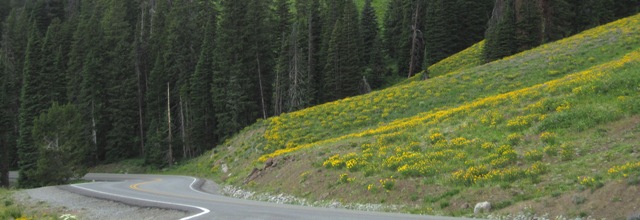
Yellowstone Wild Flowers

Success … maybe

There are days when I have difficulty deciding whether a project or workshop is working or not. On other days, I can spend time worrying about whether a decision is good or bad. Or something happens that seems frustrating and upsetting. Often the this story that I encountered a few years ago from Wisdom Tales (p.35-36) comes to mind:

A farmer’s horse ran away. His neighbors gathered upon hearing the news and said sympathetically, “That’s such bad luck.”

“Maybe,” the farmer replied.

The horse returned on his own the next morning, and brought seven wild horses with it. “Look how many more horses you have now,” the neighbors exclaimed. “How lucky!”

“Maybe,” the farmer replied.

The next day, the farmer’s son attempted to ride one of the wild horses, was thrown, and broke his leg. “How awful,” the neighbors said. “It looks like your luck has turned for the worse again.”

The farmer simply replied, “Maybe.”

The following day, military officers came to town to conscript young men into the service. Seeing the son’s broken leg, they rejected him. The neighbors gathered round the farmer to tell him how fortunate he was.

“Maybe,” said the farmer.

Success is often judged by comparing it to the outcome we expected – which is subjective. Circumstances cannot always be judged good or bad. Thomas Edison said, “I have not failed. I’ve just found 10,000 ways that won’t work.”

When things don’t seem to be going the way I hope for I often ask, “What is working well here? What do I need to keep? What do I need to let go? What lessons can I learn?”

Success? Failure? Maybe.