Idea for reflection – 12
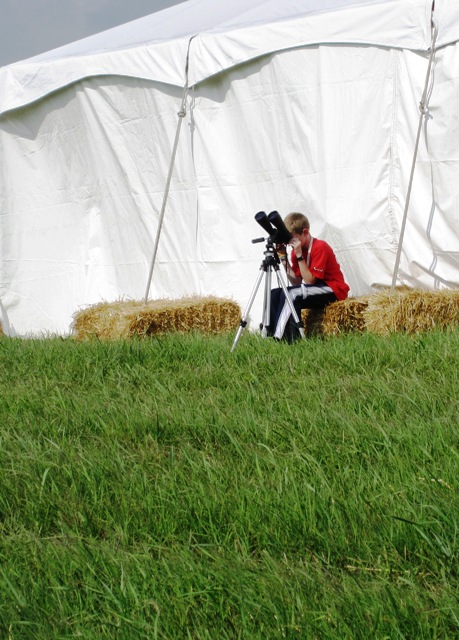
Viewing the Sun at Symphony in the Flint Hills
Here’s a quote for reflection:
The task of leadership is to create an alignmnet of strengths in ways that make a system’s weaknesses irrelevant.
– Peter Drucker

Jun 19
Viewing the Sun at Symphony in the Flint Hills
Here’s a quote for reflection:
The task of leadership is to create an alignmnet of strengths in ways that make a system’s weaknesses irrelevant.
– Peter Drucker
Jun 7
I’ve been hearing people saying that organization development and processes that focus on the positive – on building on what works well – are just a fad. While I don’t believe, think, or feel that this is a fad, I do encounter consultants and managers running “appreciative inquiry” events that are just plain boring or even completely wrong for the organization. In these scenarios, everyone behaves (or wants to behave) like the person in the recent commercial who is calling the airline to get an early flight out to escape the meeting – or perhaps they feel energized and good – but no lasting transformation occurs. What are the key components that distinguish a generative, transformative process from just another fun meeting?
It begins with good planning. If you’re bringing in an outside advisor or consultant, they need to be a skilled facilitator and someone who has the ability to facilitate a generative process. Then, instead of starting by telling everyone where you want to end up and how to get there, leaders should look for where innovation and creativity are already happening in your organization. Recognize it and get everyone involved in building an agreement about what needs will be met and what you are trying to accomplish.
Be committed to acting. Once the agreement is established, leaders step aside and affirm their permission to act. Ask everyone to create a commitment to act. This can be done by identifying one initial step that will lead forward. Leaders can then continue to bring the focus to what they want more of and fan the fire through focus, recognition, encouragement, and resources. Leaders create accountability and motivation by enabling people to grow and change, allowing autonomy while overseeing the process, and by creating meaning.
None of this alone will allow the process to be generative and transformative. The best predictor of success is the quality of leadership. Trust and transparency, legitimacy and commitment, communication and passion from leaders all increase the potential for success. Engaging people in the organization who are not directly involved, managing the informal networks as well as the formal structure all increase the potential for success.
Creating agreement about what can be accomplished together, building a commitment to action, giving structure to the process, and generating positive energy can mobilize action to meet the needs and reach the goals. Perhaps we’ll discover the courage to end management as we know it.
May 25
I’m excerpting a quote from Bob Sutton’s blog, Work Matters because it applies directly to my last several posts about feedback and how to promote learning, growth, and transformation.
“Life is a lot better when [I] think about my job as one of helping everyone be good, helping everyone learn whatever they need, and teaching where I’ve got experience and expertise. When I think in terms of helping people learn to be even better, it automatically puts me into an empathetic mode (because teaching, fundamentally, is about understanding where the learner is coming from), and that sets up the interaction really well. I can’t always stay in this teaching mode. Sometimes there are real pressures and things I need to deliver on. Sometimes external stressors in my life cause me to forget to be empathetic. But usually now I can notice when it’s happening and correct it.”
Read the entire post and comments here.
May 8
Gone are the days when the most valued words in an organization were, “It’s ATCO” (all taken care of). Generation Xer’s and even Boomers were focused on taking work from those above them and just getting it done — independently. But a new generation is entering the workforce, shaking things up with their arrival.
While everyone in the workplace has the ability to work on teams, the Millennial Generation (also known as Generation Y or Generation Next) have been raised with “team.” It began when they were taking their first steps and were cheered aloud by their families. It continued as families with two working parents or a single parent interacted like teams with each person fulfilling their role. The Millennials have done group projects in school, participated in team sports at an unprecedented level, and embraced on-line social networks.
In a recent survey by Select Minds Research, 77% of Millennials stated that collaboration was the most important driver of work satisfaction; and, 28% reported leaving a job because they felt isolated or disconnected from the larger organization. Yet the older generations have often said, “We need to figure out how to get them to conform to the workplace. Welcome to how “real life” works.” I will argue that it is more productive to take the approach of discovery.
Organizations can discover ways to jumpstart the desire of Millennials to reinvent work as a team sport by creating ways for new Millennial hires to connect with all generations in the workplace. Two ideas that I’ve encountered are to create multi-generation special interest groups and young leader groups.
Both of these ideas have been used to good effect with unexpected outcomes that exceeded everyone’s expectations. The special interest group has created an external team that interfaces regularly with the community, supporting a wide variety of community events and presenting a professional face for the organization that has not been seen in the past. One of the new leader groups that I’m familiar with is now presenting their ideas about engaging the next generation around the U.S. — with full support from upper management.
Millennials are inventing teams in ways that Generation Y and Boomers have not been able to imagine. Engaging the new generation and any new workforce entrant brings opportunities to change processes and challenge the status quo. The resulting innovations, ideas, and skills have the potential to benefit organizations and communities who are willing to embrace their desire to collaborate.
May 6

View from the Conductor's Circle
A man who wants to lead the orchestra must turn his back on the crowd.
– James Crooks
And a TED talk by a conductor: “Itay Talgam demonstrates the unique styles of six great 20th-century conductors, illustrating crucial lessons for all leaders.”
Apr 20
(This is a guest post from Justin Anderson. Justin is a Licensed Sport Psychologist and Principal of JSA Advising, a Minneapolis/St.Paul consulting firm that specializes in optimizing sustainable performance and harmony in family-owned businesses. Justin’s worked with athletes/teams from all competitive levels, and over the past five years, he’s used those experiences to help family-businesses build thriving and sustainable legacies. Justin can be reached through JSA Advising. Thank you, Justin!)
What motivates you to act? Contemporary thought can reduce human motivation into two basic modalities; fear and desire. If you are like most, you will likely find that you do many things in your daily routine out of fear. For example, many people get up in the morning with less than ideal sleep, not because they desire the feeling of being tired. Rather, they do it because they “fear” the consequences of not getting up “on-time”. For many, not getting up “on-time” means missing work and missing work means getting fired and getting fired could mean losing the house.
It’s not too often that we consciously connect all the dots. Rather, we typically go through our routines automatically, because it’s what we “need” to do. It’s why so many of us are tired, stressed, and anxious. Taking consistent action through the fear perspective leads to higher levels of anxiety and tension which, over a longer period of time, leads to poorer health, less meaningful relationships, and a decreased ability to process information clearly.
In addition, taking action from the fear motivator can lead us to be critical of ourselves or those around us. Negativity breeds negativity. Like an out of control snowball, if you find that fear is your dominate motivator, than it’s likely that you could be contributing to a work place environment that is more judgmental and paranoid. And a workplace that is judgmental and paranoid will create more negativity and fear. Ultimate result: a work place where creativity and productivity is stifled or even frowned upon.
The solution to ending the negativity spiral can be found by developing a keener sense of self-awareness and self-accountability. It calls for us to slow down and reflect on the “why” as we check-off our to-do lists. It requires us to retrain our neural networks to focus on things we can control as well as to be able to let go of the things we cannot. And, it requires us to focus our attention on the things for which we are grateful and that give us positive energy.
This final requirement is not as easy as it sounds. The human mind instinctively wants to solve the “problems first”, a practice that served our ancestors well when they were looking for food and avoiding predators. But today when our physiological needs are fairly secure, this type of thinking doesn’t do us any favors. Instead, it creates a negative lens that primarily focuses on problems that we cannot control or those things that we are still “missing in our lives”. Being able to retrain the brain to instinctively focus on the things we can control and are grateful for creates a greater sense of tranquility, thus relaxing the tension, opening the mind to new and innovated ways to get our needs met through our desire motivator.
Don’t abuse: Like all good things in this world, too much of a good thing can lead us right back down the negativity path again. By suggesting that we operate out of our “desire” motivation, I’m not suggesting that we ignore all the rules and moral guidelines and become hedonistic. Rather, I am simply pointing out that on the spectrum of motivation, many of us act far too often from fear. If we acted more firmly from our desire modality (within reason) we would also find that positivity is contagious. Similar to how negativity can breed negativity, positivity and gratefulness can breed a healthy and energetic environment, fostering increased creativity, greater productivity, and more meaningful relationships.
If you are a leader or manager, consider what motivator drives your actions.
Dec 16
Jon and I have long put forward the idea that leadership and management are two different things. We’ve defined management as the action of organizing the details of day-to-day operations. But often the word organizing becomes controlling. Yet years of research in human and organizational behavior show that controlling won’t get organizations the results they want.
Daniel Pink has a new book coming out in a few weeks. Here’s an excerpt:
Management is great if you want people to comply – to do specific things a certain way. But it stinks if you want people to engage – to think big or give the world something it didn’t know it was missing. For creative, complex, conceptual challenges – i.e, what most of us now do for a living—40 years of research in behavioral science and human motivation says that self-direction works better.
And that requires autonomy. Lots of it.
If we want engagement, and the mediocrity busting results it produces, we have to make sure people have autonomy over the four most important aspects of their work:
Task – What they do
Time – When they do it
Technique – How they do it
Team – Whom they do it with.
After a decade of truly spectacular underachievement, what we need now is less management and more freedom – fewer individual automatons and more autonomous individuals.
. . . something worth thinking about. The challenge is to have the courage to go beyond thinking to gathering the courage to make the shift to a new way of engaging individuals in the workplace. If you want more to think about today, check out Justin Anderson’s take on shifting organizational culture.
A recent diary entry from an employee in a research study was titled, “The Reality Management Never Sees.” While managers may have an unspoken agenda in the workplace, what they can’t see is how employees process life at work. In order to learn what happens inside of employees’ minds, for three years, researchers studied 238 professionals – persons who use their knowledge collaboratively to solve problems. The question for reflection in this post is, “What is the reality managers can’t see and how does understanding that reality change how they manage?”
The research shows that every person is affected by emotions created by reactions to events at work and by how they perceive and make sense of these events. This interplay of emotions and perceptions drive employees’ process of choosing what tasks to perform, how to do a task, and where to do it or in other words: their motivation to perform. While this may not be surprising to a manager who has reflected on the question of how employees experience the workplace, the argument among managers is how performance is influenced by employees’ subjective experience.
The debate between managers is whether employees perform better when they’re self-directed, happier, and love what they’re doing or when supervisors pressure them to meet objectives and design competition among peer groups. The evidence showed three elements impacting performance:
High performance was described as increases in productivity, a commitment to the work at hand, and respect for and contribution to the work of team members. The inner reality of employees clearly impacts effectiveness, productivity, and team participation. So what can managers do that will have the biggest impact on employees’ inner experience – emotions, perceptions, and motivation?
Surprising to me was what did not make the list of good management behavior: daily thanking an employee, working side-by-side with an employee as a peer, injecting lighthearted jokes, or buying a pizza for lunch. While these do have an impact, the most important and fundamental management activities were:
As employees are connected to their work 24/7 ripple effects from organizations spread through employees’ lives. This knowledge emphasizes the importance of understanding the inner life of employees, It is good for our organizations and reaffirms life and our value as human beings.
Read more about Inner Work Life at http://www.rotman.utoronto.ca/pdf/winter2008.pdf
Aug 27
You’re the coach. It’s the NCAA basketball finals. Your team is down by 1 point with 4 seconds to go. Do you want your all-star rookie or your 4-year, seasoned veteran to take the last shot? My guess is that you’ll choose the seasoned player, even if her stats are not as impressive as the rookie’s. Experience in performing under pressure can give the seasoned player better odds.
Seasoned players and leaders have spent years reflecting on the situations they’ve encountered, considering what worked and what did not, observing what was required to meet the challenges. Reflection is an important part of personal development. The goal of reflection is understanding, synthesis, and integration of experience. It is not about judging the past as bad or good, criticizing yourself, or self-aggrandizement. It’s taking time to think about and recognize what happened, accepting the past as it is. Then it’s taking the next step to learn from what happened and identify your role, behavior, and response.
Think there isn’t time to reflect? I use the time spent driving to-and-from events or meetings. I often take a walk in the early evening. And, I set aside specific time to write and think each week. All of life’s experiences can teach us things if we are open to reflecting and learning.
The best leaders, the ones developing field leaders, won’t be the ones standing around at the water cooler. They are the ones working to get things done. But they don’t get things done by doing everything themselves. They start by looking around at the people they are responsible for leading and assessing their strengths and weaknesses.
A good leader knows that the people around them may possess strengths that the leader does not and is willing to allow people to be good at what they do. A good leader also assesses areas that need to be improved. Developing these areas will go a long way to creating new leaders. The challenge in developing leaders is to construct the environment and situations which will challenge people to develop and stretch their knowledge and abilities, even allowing them to fail — without significant consequences.
Once a challenge has been met, it is important to do two things: The first is to review what worked and what didn’t. Respectful dialogue and healthy debate can be part of a process that can improve not only the field leader, but the entire organization. The second is to go out and try again. In Outliers, by Malcolm Gladwell, the research is presented showing that people who are expert at their chosen task have practiced it for more than 10,000 hours. Trying again, assessing, improving, and trying again has been called by many different names over the years – from Total Quality Management to After Action Review; it is a proven method for exercising, growing, and building capacity.
The leaders who develop other leaders get things done. They don’t give up. They create challenging opportunities. They continuously act, learn, and improve. They put the well being of the organization and their people ahead of their own interests. They are committed to doing excellent work, work that makes a difference and is sustainable over time.


 Friesen Group