Idea for reflection – 32
I am enough of an artist
to draw freely upon my imagination.
Imagination is more important
than knowledge.
Knowledge is limited.
Imagination encircles the world.
– Albert Einstein

Jul 22

I am enough of an artist
to draw freely upon my imagination.
Imagination is more important
than knowledge.
Knowledge is limited.
Imagination encircles the world.
– Albert Einstein
Jun 24

In one of those journeys that can only happen on the web, where link-leads-to-link, I discovered Oblique Strategies. The idea of Oblique Strategies is that disruption increases creativity. Disrupting the patterns we live and work by, allows our brains to take notice and generate something different. To break the pattern or shift your brainstorming session, try one of the prompts: “Emphasize differences” – “Use an old idea” – “What mistakes did you make the last time?” – “A line has two sides”- “What are you really thinking about just now?”
The original Oblique Strategies appeared on a card deck. These have since been translated to the web, iPod, etc. Try a prompt today!
Jun 10
May 12
 The Atlantic magazine has a project called “First Drafts: How Genius Works.” The interviews with novelists, chefs, architects, and musicians are a creative process x-ray. Here are a few excerpts that resonate with me:
Frank Gehry on how our creations are a reflection of ourselves, “Some people may say my curved panels look like sails. Well, I am a sailor, so I guess I probably do use that metaphor in my work—though not consciously.”
Tim Burton on the need for space, “I don’t sit down and try to draw a character. I attempt to reserve some time each day for myself to sit and do nothing—stare off into space or doodle or whatever–just be in my own head. That time is very precious for me, and sometimes the characters will strike me in these quiet moments.”
Grant Achatz on iterations before putting food on the table, “We do different tests of every dish. Someone will have an idea, work on it, and put something in front of me. I’ll taste it and make comments and suggestions. We’ll continue the process until we all think it’s where we want to be.”
I invite you to explore the project and let me know what inspires you!
Apr 30

The window has forty
panes, forty clarities
variously wrinkled, streaked
with dried rain, smudged,
…
The window is a form
of consciousness, pattern
of formed sense
through which to look
into the wild
that is a pattern too,
bearing along the
shapes of the mind
…
The windy day
on one of the panes
a blown seed, caught
in a cobweb, beats and beats.
– Wendell Berry, excerpted from Window Poems 3
Apr 25
 I’ve been writing about the Stanford d.school and their design thinking process. In a new article in the Stanford alumni magazine, President John Hennessy is quoted,
It’s much harder to teach creativity. [It involves] multiple routes, multiple approaches and, obviously, it’s virtually impossible to test whether or not you’ve succeeded. The measure of success is likely to come long after, not unlike many of the other things we try to teach: To prepare students to be educated citizens, to prepare them for dealing with people from diverse and different walks of life. Those are things that play out over a long time, whether or not we’ve done a good job.
But the core curriculum supports just that: learning to be imaginative and creative. Students learn techniques for “interviewing, observing, suggesting, tinkering, reviewing and then perhaps completely restarting two, three or four times.”
What are you taking time to observe? Who are you interviewing to understand their perspective on working or doing business with your organization? What will you try, test, and re-design until you get it right – a new product, an improved process, a customer experience? Who you do you meet with regularly who is outside of your industry or discipline that can stretch your ideas and imagination?
Sparks Fly: Can imagination be taught?
d.school – Bootcamp Bootleg
d.school – Research by Design
Mar 18

The important thing is not to stop questioning. Curiosity has its own reason for existing. One cannot help but be in awe when he contemplates the mysteries of eternity, of life, of the marvelous structure of reality. It is enough if one tries merely to comprehend a little of this mystery every day. Never lose a holy curiosity.
– Albert Einstein
Jan 13
 Last night I was working with a class of kindergarten and first graders. Walking around the table, I observed that one of them had taken the coloring picture page, turned it over to the blank side, and was drawing his own picture.
I commented, “That is a very interesting picture. You’re really using your imagination. Will you tell me the story that goes with the picture?”
Immediately, we were interrupted by a sixth grader, who was working as an assistant. She stated matter-of-factly, “My teacher got rid of my imagination.”
I absorbed this amazing statement and asked, “How did your teacher do that?”
“Well – first semester, he told us we could only write about facts and to get rid of our imaginations. So I did. But now (second semester), he told us we need to use our imaginations to write stories; but I can’t seem to find mine anymore.”
I’m still reflecting on this interaction, seeing implications on many different levels …
… can take the lowly hedge apple

Fall Hedge Apple
… and create a work of art:
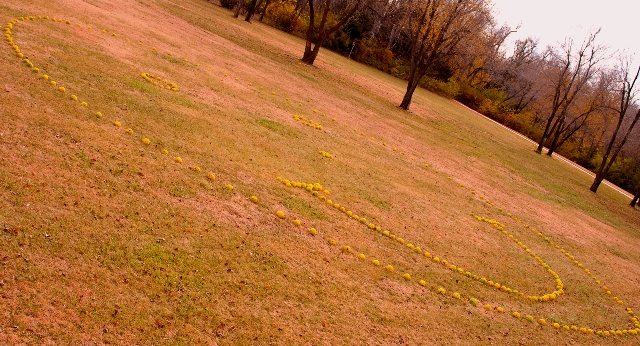
Hedge Apple Smiley Face
Thanks to the neighborhood kids and their creativity!
Nov 24
All children are artists. The problem is how to remain an artist once he grows up.
–Pablo Picasso
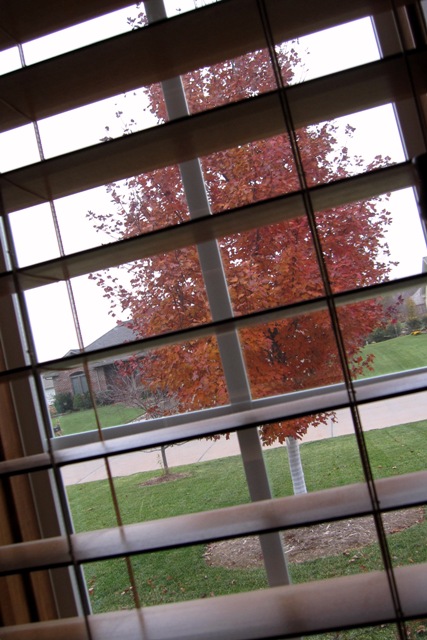
How do you experience individual moments throughout the day? Do you see what is around you? Do you incorporate what you see into your ideas and opinions? Do you let it move you? Is it fun!? Here are some things I’ve seen in the last three days:




 Friesen Group